

Board Performance · 2025
In this section12 topics
- Prevention of Conflicts of Interest3 items
- Prevention of the Use of Inside Information3 items
- Anti-Corruption5 items
- Whistleblowing5 items
- Selection of Directors & Chief Executives6 items
- Selection of Independent Directors2 items
- Director Development2 items
- Evaluation of Board & Subcommittee Performance2 items
- Subcommittees1 item
- Meeting Attendance & Remuneration3 items
- Supervision of Subsidiaries & Associated Companies4 items
- Audit Committee Duty Performance1 item
Prevention of Conflicts of Interest
Has the Company Acted to Prevent Conflicts of Interest?
Yes
Operations in the Past Year
The Company is committed to conducting business with honesty, integrity, transparency and responsibility for its actions. Therefore, the Board of Directors has determined that any transactions with major Shareholders, Directors, executive or persons related to such persons must be considered by the Audit Committee, which will carefully oversee every step of the approval process for the transaction and strictly comply with the criteria and methods set by the Stock Exchange of Thailand (SET), the Securities and Exchange Commission (SEC) and the Capital Market Supervisory Board. Details of the transaction, the value of the transaction, the contracting party and the reasons are disclosed transparently to the public immediately via the electronic media of the Stock Exchange of Thailand via the SET Community Portal system: www.setportal.set.or.th and disclosed in the annual information disclosure form (Form 56-1 One Report).
Preventing Conflicts of Interest
All executives and employees must avoid engaging in activities that could create a conflict between personal interests and the Company's interests, especially when interacting with business partners and other individuals.
While employed by the Company or after termination of employment, executives and employees must not disclose any confidential information belonging to the Company for personal benefit. This includes electronic information, financial data, performance information, business strategies, future plans, and any other information that could harm the Company.
If executives or employees hold positions as directors or consultants in other companies, organizations, or business associations, they must inform the Company and obtain approval.
Executives and employees must not borrow money from business partners with whom the Company conducts business, as this could influence their duties as the Company’s representatives. The exception to this is financial institutions.
Executives and employees are prohibited from selling, transferring, or using the Company's money or assets for any person without prior approval from an authorized individual.
All executives and employees must dedicate their time and efforts to the Company's business. If additional work is necessary for personal income or other purposes outside of working hours, it must meet the following criteria:
It does not violate the law or contravene public order, peace, or morals.
It does not conflict with the Company's interests.
It does not harm the Company's reputation or business.
It does not involve using the Company’s confidential information for personal benefit or that of relatives.
Number of Conflict-of-Interest Cases
| Metric | Current Year | Previous Year | Two Years Ago |
|---|---|---|---|
| Total number of cases or issues related to conflicts of interest (cases) | 0 | 0 | 0 |
Prevention of the Use of Inside Information
Has the Company Acted to Prevent the Use of Inside Information?
Yes
Operations in the Past Year
The Company is a listed company on the Stock Exchange of Thailand, and thus it is a crucial policy to ensure equality and fairness for all Shareholders. Inside information or material news that could affect securities prices and has not yet been disclosed to the public is considered inside information used in business operations and is deemed confidential by the Company. Its disclosure would have an impact on the Company.
The protection of inside information is crucial for the Company's success, as well as for the financial security of all personnel. To ensure that the dissemination of information to external parties does not cause damage to the Company's business and reputation, measures and systems for controlling inside information have been established. Personnel must strictly adhere to the Company's regulations regarding the use of inside information, including maintaining its confidentiality and not using it for personal gain, even after their employment or duties have ceased.
Management of Inside Information Usage
All Shareholders of the Company must be treated equally and fairly according to their fundamental rights. Therefore, the Board of Directors has established a governance policy to prevent Directors, executives, and employees who possess significant company information from misusing inside information that has not yet been generally disclosed to the public, whether for personal gain or for the benefit of others, as follows:
The use of inside information must be strictly within the scope of one's assigned duties and responsibilities.
Directors, executives, or employees who possess inside information, including their spouses and minor children, are prohibited from using the Company's inside information that has not yet been generally disclosed to the public for personal gain or for the benefit of others, which includes trading securities. Specifically, a policy has been established prohibiting securities trading during a blackout period, which is at least 30 days before the Company's financial statements are generally disclosed to the public and for 24 hours after such disclosure.
Directors, executives, or departments that receive inside information are prohibited from disclosing it to external parties or individuals who are not involved in relevant duties.
Ensure that Directors and executives report changes in securities holdings to the Securities and Exchange Commission in accordance with Section 59 of the Securities and Exchange Act B.E. 2535.
In December 2025, the Company Secretary Office conducted an awareness campaign on the use of insider information, related regulations, and company rules for all levels of company employees, management, and the Board of Directors. This was done through published documents and video clips via the Company intranet, email, and LINE groups. Records of those who received this information were kept. All new employees are required to complete this training on the use of insider information and related regulations before beginning their employment with the Company.
In 2025, no violations of policies and regulations concerning the use of inside information were found.
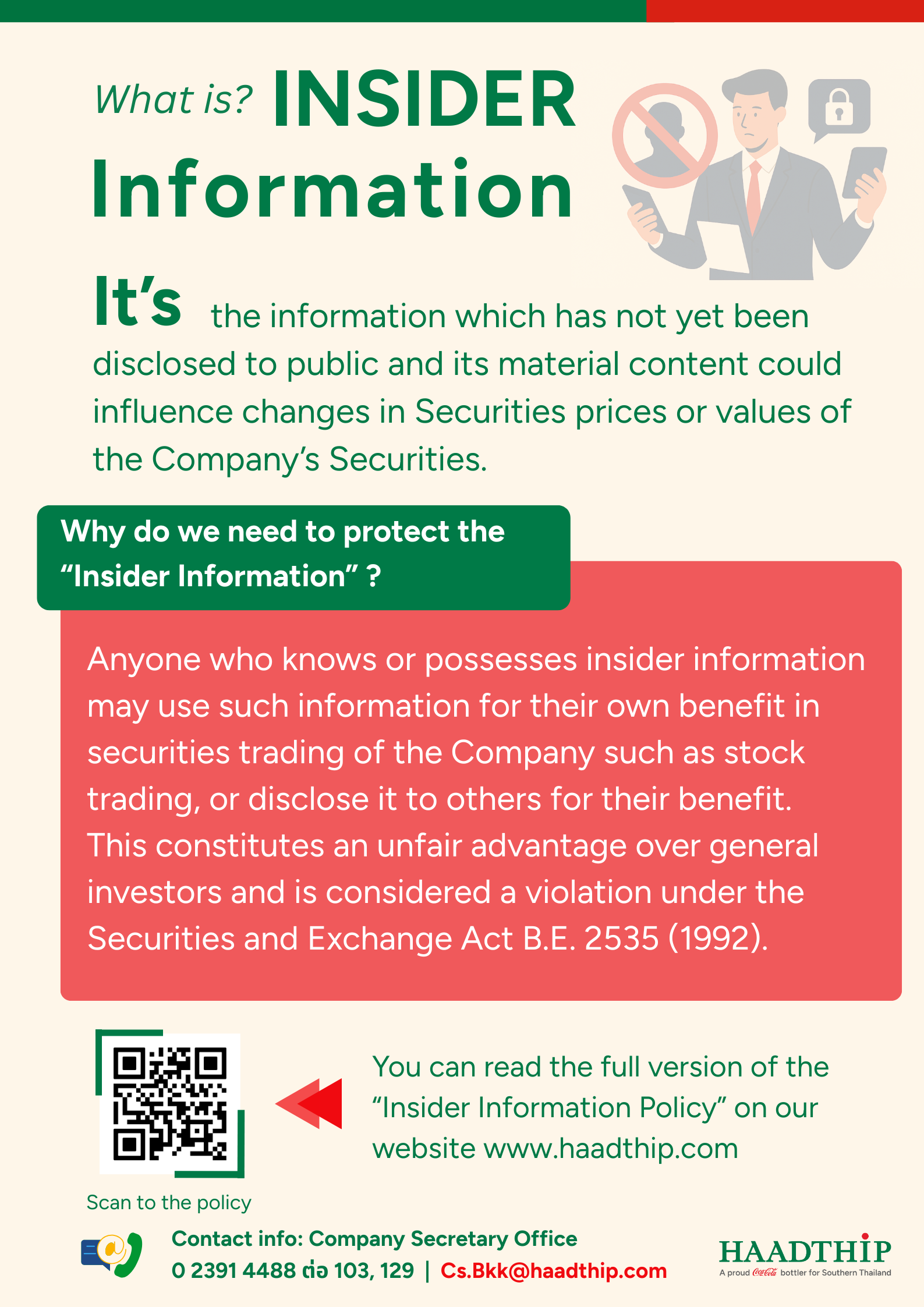
Part of educational and awareness materials on data usage by December 2025.
Number of Inside-Information Cases
| Metric | Current Year | Previous Year | Two Years Ago |
|---|---|---|---|
| Total number of cases or issues related to the use of inside information to seek benefits (cases) | 0 | 0 | 0 |
Anti-Corruption
Has the Company Acted on Anti-Corruption?
Yes
Operations in the Past Year
The Company's business operations with stakeholders will be conducted with transparency and integrity, in compliance with relevant laws and standards, and will encourage partners to adhere to anti-corruption policies. The Company has passed the 71-item self-assessment, with a 3-year certification period (2024-2027), marking its third consecutive certification, which will expire again in 2027. This project was organized by the Thai Institute of Directors Association, supported by the government and the National Anti-Corruption Commission (NACC) since 2013. This certification demonstrates the principles of conducting business with honesty, transparency, and fairness, rejecting all forms of corruption, both direct and indirect, while considering responsibility towards the community, society, and the environment, to establish business standards based on good corporate governance, and to build confidence among investors and the stock exchange. Furthermore, it is crucial to foster and instill in employees a sense of honesty and transparency in performing their duties, ensuring they do not overlook or ignore acts of corruption. The Company emphasizes communication to ensure that employees at all levels and all stakeholder groups are aware of the management's intentions, which include:
Developed a Business Code of Conduct manual and distributed it to executives and employees, as well as communicated it as an e-document via the Company's intranet and application.
Developed a Supplier Code of Conduct manual in Thai and English, and communicated it to partners.
Included as a main topic in new employee orientation regarding the Employee Code of Conduct, and provided refresher training to all employees annually, along with monthly communication and knowledge activities.
Organized training for directors and executives on the course "Enhancing Corporate Governance and Anti-Corruption in the Organization."
Organized activities to promote knowledge of good governance among youth: "Good Children with Morality."
Organized bidding activities to select manufacturers of promotional materials, organized bidding activities for scrap materials.
Organized bidding activities, communicated the Supplier Code of Conduct.
Organized anti-corruption campaigns (video clip contest, No Gift Policy media design contest).
Organized Supplier Day 2025 conference: "HaadThip: Together for Good"
Organized Sales Conference 2025: Corporate Governance Exhibition.
Form of Anti-Corruption Operations
| Operation |
|---|
| Communication and training for employees on anti-corruption policy and guidelines |
| The monitoring of the evaluation of compliance with the anti- corruption policy |
| Assessment and identification of corruption risk |
| The participation in anti-corruption projects |
| Review of appropriateness in anti-corruption |
Number of Corruption Cases
| Metric | Current Year | Previous Year | Two Years Ago |
|---|---|---|---|
| Total number of cases or issues related to corruption (cases) | 2 | 0 | 0 |
Details of Corruption Cases
| Status | Period Type | Start of Period | End of Period | Details of the Case or Issue | Investigation Results | Corrective Actions |
|---|---|---|---|---|---|---|
| Incident no longer subject to action | month/year Range | 2025-07 | 2025-10 | Fraud in shipping and risky behaviors that can lead to fraud. | An investigation was conducted and irregularities were detected. | Establish procedures to prevent recurrence. |
Whistleblowing
Has the Company Implemented Whistleblowing Procedures?
Yes
Operations in the Past Year
The Company provides channels for receiving tips, complaints, and suggestions indicating that stakeholders have been affected or are at risk of being affected, causing damage to stakeholders from the Company's business operations or from employee conduct related to legal or ethical violations, including behavior that may suggest corruption, unequal treatment, or actions lacking caution and prudence, through the following channels and processes:
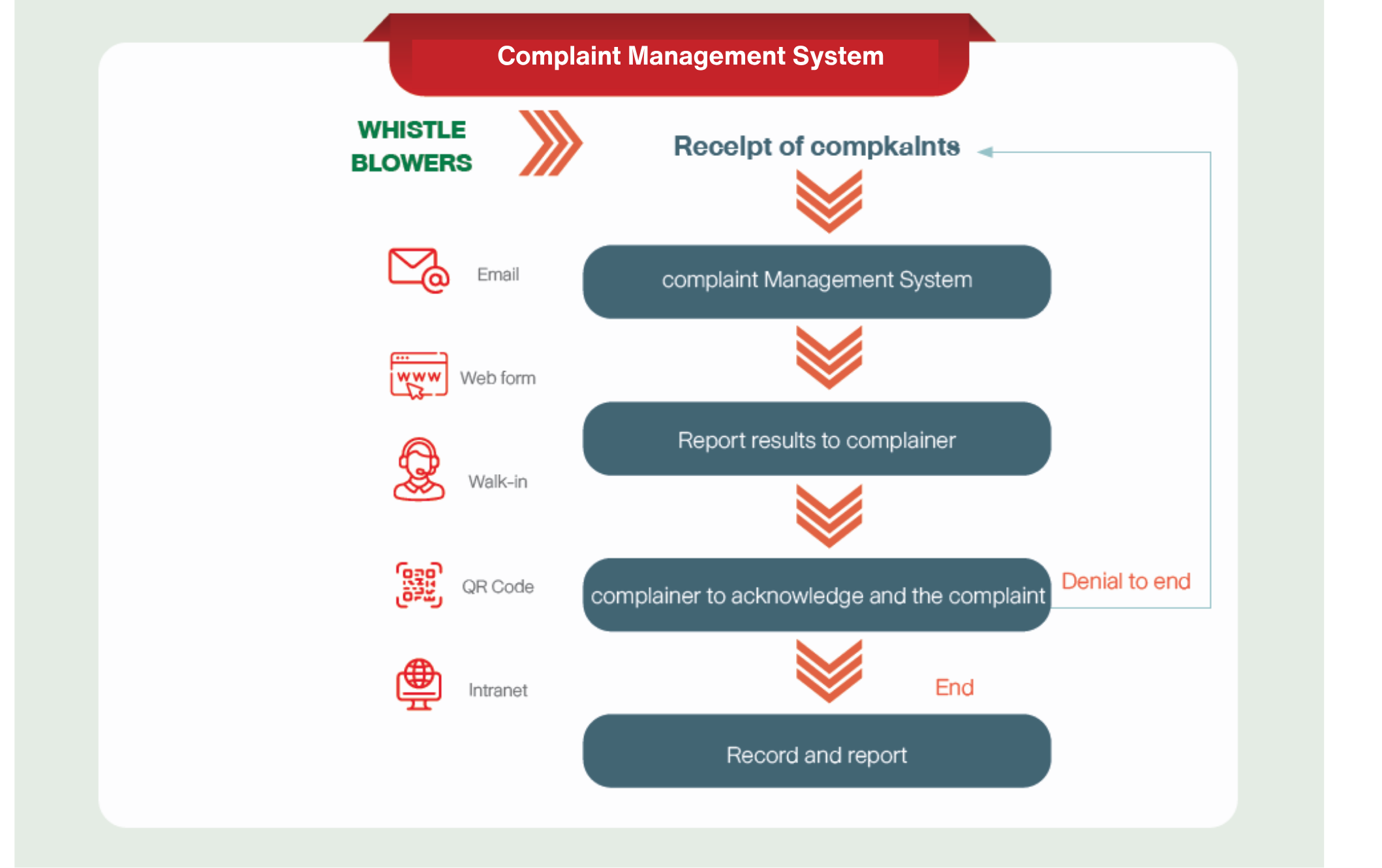
Employees or stakeholders can report tips, complaints, comments, or suggestions through designated channels. The Company will investigate and record the factual inquiry in writing, without disclosing the details of the whistleblower, and will keep complaint information confidential to protect against potential impacts. If the matter is found to be true, an inquiry committee will be established to summarize a report for the Disciplinary Committee to make decisions and specify disciplinary actions. This process employs the principle of Check and Balance to ensure equilibrium and fairness to all parties.
Number of Whistleblowing Cases — Introduction
In 2025, the Company received 168 complaints through various channels. All these complaints were successfully resolved, and the complainants expressed satisfaction with the solutions. These are categorized into 2 channels as follows:
Channel | Number of Complaints | Note |
Internal Complaints | 2 | Measures Completed |
External Complaints | 166 | Measures Completed |
Of the complaints, two are related to corruption; the other complaints concern improvements to products and services.
Number of Whistleblowing Cases
| Metric | Current Year | Previous Year | Two Years Ago | Remark |
|---|---|---|---|---|
| Total number of cases or issues received through whistleblowing channels (cases) | 2 | 0 | 0 | Issues related to corruption only. |
Details of Whistleblowing Cases
| Status | Period Type | Start of Period | End of Period | Details of the Case or Issue | Investigation Results | Corrective Actions | Case or Issue |
|---|---|---|---|---|---|---|---|
| Incident no longer subject to action | month/year Range | 2025-07 | 2025-10 | Fraud in shipping and risky behaviors that can lead to fraud. | An investigation was conducted and irregularities were detected. | Establish procedures to prevent recurrence. | 3189 · Description: Anti-corruption · 3198 · Description: Whistleblowing and Protection of Whistleblowers |
Selection of Directors & Chief Executives
Selection — Introduction
The Company’s directors are knowledgeable and experienced in the industry that the Company is operating. The Company’s directors are capable of working effectively, offering viewpoints and visions useful for business operation including risks, related to the Company’s business. Moreover, all the Directors of the Company are qualified persons without any incompatibilities, as specified by the Public Company law and the Securities and Exchange Law. Each of the Independent director full qualifications, as specified in the SEC’s announcement at Tor Jor 4/2552 Re: Asking for and Giving Permission to Offer for Sale of Newly Issued Shares (No. 2) (announced at Tor Jor 4/2552).
Directors
The election of the Board of Directors shall abide by the Company’s regulations and related laws. The Shareholders’ Meetings shall consider election of Directors, according to the following criteria and methods.
Each Shareholder has a voting right equivalent to one share to one vote;
For a Director election, the Shareholders can cast their votes to elect one Director, or a group of Directors at a time, or by any other methods as deemed appropriate by the Shareholders’ Meeting. During the voting procedure, however, the Shareholders can only exercise their voting right as per condition (1) above, and cannot allocate any portions, less or more, of their voting rights to any one Director or group of Directors;
The appointment of Directors shall be decided by majority votes. If the votes are tied, Chairman of the Meeting shall cast the vote to determine the final outcome.
At the vote to determine the final outcome one third of the Directors shall be retired. If the number of Directors cannot be divided evenly by one third, the number of retiring Directors shall be as close to one third as possible. The names shall be drawn and announced, for Directors to retire in the first and second year following registration. But for the following years, the method employed will be to retire the Director with longest tenure. In the case that the number of Directors with longest tenure exceed that of the number of Directors to retire at that time, the names of Directors to retire at that time shall be drawn.
The Nomination and Remuneration Committee considered directors retiring from office by rotation to be reelect and propose to the Board of Directors for consideration. The Board of Directors will consider to propose Directors retiring from office by rotation to be reelect and propose to Shareholders’ meeting.
For directors' election in 2025, the Company has provided an opportunity for Shareholders to propose agendas and propose names of persons to be considered for election as directors in advance between 1 November 2024 and 31 December 2024, a period of 2 months (61 days), but no Shareholders have proposed agendas or proposed names of persons to be considered for election as directors.
Directors & Chief Executives — Introduction
New Directors
The Nomination and Remuneration Committee select qualified person to be the Company’s Directors without any incompatibilities, as specified by the Public Company law and the Securities and Exchange Law. Each of the Independent Director full qualifications, as specified in the SEC’s announcement at Tor Jor 4/2552 Re: Asking for and Giving Permission to Offer for Sale of Newly Issued Shares (No. 2) (announced at Tor Jor 4/2552). The Nomination and Remuneration Committee are to propose new qualified Directors to the Board of Directors for consideration. If the new Director is not to replace resigned Directors, the Board of Directors is to consider to propose to Shareholders’ meeting for election. There is a orientation plan for new Directors, taken place within 3 months after entering the position to communicate the working procedure of the Company.
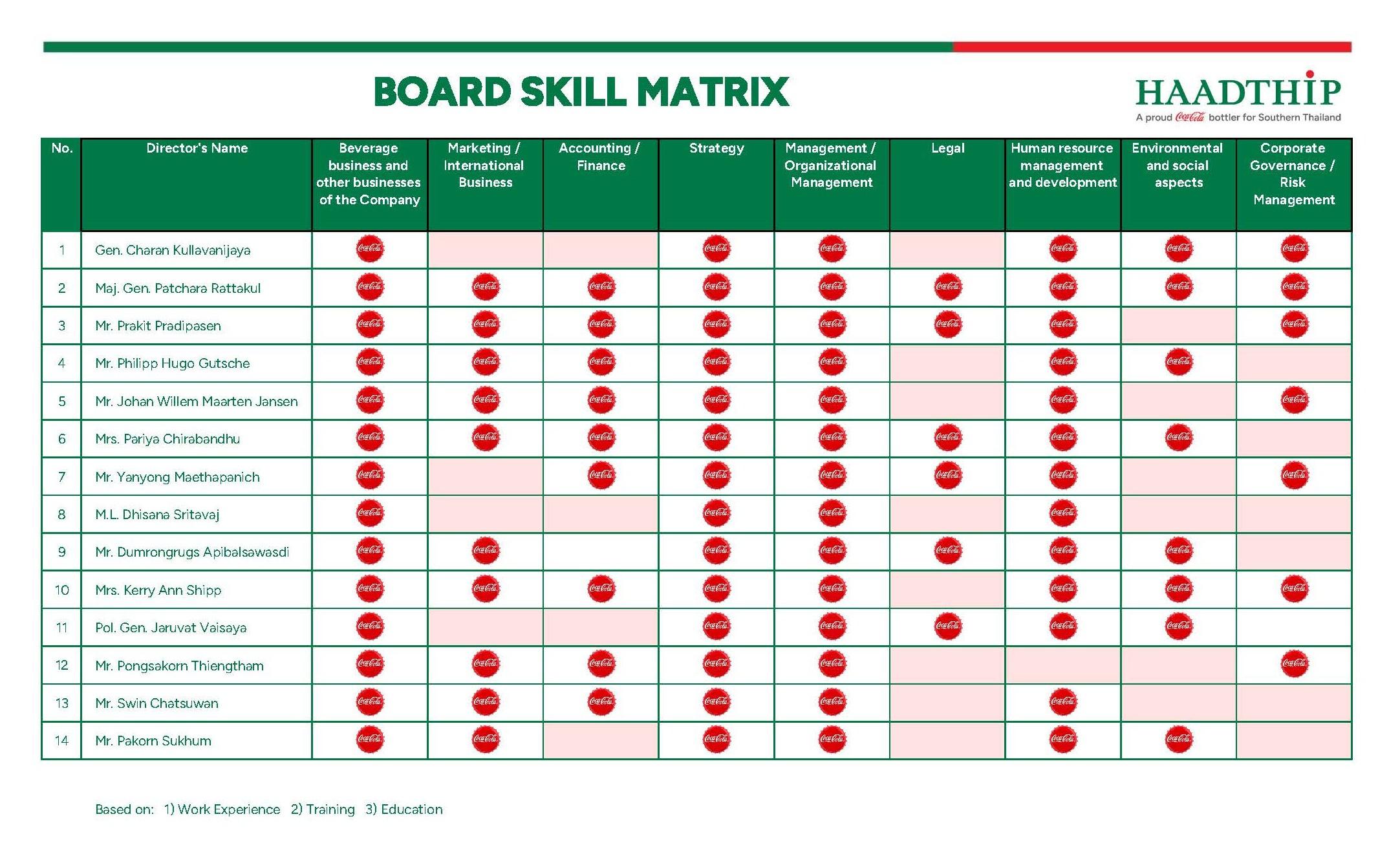
The Company has developed a Skill Matrix for its Board of Directors to ensure that the Board members possess comprehensive and well-rounded skills. This also enhances the Company's competitiveness in the market and is used in the recruitment of new Directors. The Board Skill Matrix is publicly available on the Company website: https://www.haadthip.com/en/about/good-corporate-governance
Chairman of the Board of Directors
The Chairman of the Board of Directors must have knowledge, experience and abilities appropriate for the Company, with the Board selecting one Director to hold the position.
Top Executive/CEO
The Nomination and Remuneration Committee is responsible for screening the recruitment, selection and determination of remuneration of senior executives based on various key factors, including knowledge, capabilities and experience related to the business. The Board of Directors will select the top executive/Chief Executive Officer proposed by the Nomination and Remuneration Committee. A Succession Plan is systematically developed, including knowledge and capabilities development, and the results are systematically evaluated. The selection criteria will prioritize candidates who possess the necessary skills, knowledge, abilities, leadership qualities, and experience that are beneficial to the business operations and align with the Company's strategic plan.
A Succession Plan for top executives/Chief Executive Officers includes:
The selection process and stakeholders, including the timeframe.
Key qualifications, experience, and knowledge.
Leadership qualities.
Development plan for internal candidates.
Development plan upon assuming the top executive/Chief Executive Officer position.
Are Directors Selected Through the Nomination Committee?
Yes
Are Chief Executives Selected Through the Nomination Committee?
Yes
Rights of Minority Shareholders on Director Appointment
The Company has provided an opportunity for Shareholders to exercise their rights to nominate persons to be considered for election as Directors of the Company. Shareholders of the Company who hold shares continuously of not less than 5 percent of the total number of voting shares of the Company, which may be a single Shareholder or multiple Shareholders combined, and hold shares continuously from the date of holding shares to the date of proposing the matter to be included in the meeting agenda or the date of proposing persons to be considered for election as directors for a period of not less than 12 months.
For the Annual General Meeting of Shareholders in 2025, Shareholders had been given the opportunity to nominate persons to be considered for election as Directors of the Company from November 1, 2024 to December 31, 2024, totaling 2 months (91 days), without any Shareholders proposing any names.
Method of Director Appointment
| Method |
|---|
| Method whereby each director requires approval votes more than half of the votes of attending shareholders with voting rights |
Selection of Independent Directors
Criteria for Selecting Independent Directors
Independent Directors must have qualification according to The Notification of the Capital Market Supervisory Board no. TorJor. 39/2559 and not hold share worth more than 0.5 percent of paid-up capital of the Company, including with share which held by any person who has related to Independent Director.
Did Any Independent Director Have a Business or Professional Relationship?
No
Director Development
Development of Directors in the Past Year
The Board of Directors supports and arranges for Directors to consider attending training courses with the Thai Institute of Directors Association (IOD) or other suitable organizations. The Company Secretary is assigned to coordinate and inform Directors about various training courses aimed at developing their capabilities and improving their performance as Directors on an ongoing basis.
In 2025, 8 Directors participated in training and seminars, with a total of 3 courses/seminars as follows:
Maj. Gen. Patchara Rattakul, Corporate Governance and Anti-Corruption Program (2025) by the Private Sector Collective Action Coalition Against Corruption (CAC).
Mrs. Pariya Chirabandhu, Corporate Governance and Anti-Corruption Program (2025) by the Private Sector Collective Action Coalition Against Corruption (CAC).
Mr. Yanyong Methapanich, Corporate Governance and Anti-Corruption Program (2025) by the Private Sector Collective Action Coalition Against Corruption (CAC) and Insight in SET: ID & AC Focus - Comprehensive Knowledge for Growth and Sustainability in the Capital Market (2025) by the Stock Exchange of Thailand.
Mr. Dumrongrugs Apibalsawasdi, Corporate Governance and Anti-Corruption Program (2025) by the Private Sector Collective Action Coalition Against Corruption (CAC).
Ms. Kerry Ann Shipp, Corporate Governance and Anti-Corruption Program (2025) by the Private Sector Collective Action Coalition Against Corruption (CAC).
Mr. Pongsakorn Thiengtham, Corporate Governance and Anti-Corruption Program (2025) by the Private Sector Collective Action Coalition Against Corruption (CAC).
Mr. Swin Chatsuwan, Corporate Governance and Anti-Corruption Program (2025) by the Private Sector Collective Action Coalition Against Corruption (CAC).
Mr. Pakorn Sukhum, The Board’s Role in Mergers and Acquisitions (BMA) Program, 15th Batch/2025, by the Thai Institute of Directors Association (IOD) and Corporate Governance and Anti-Corruption Program (2025) by the Private Sector Collective Action Coalition Against Corruption (CAC).
Qualifications for Director Selection
| Qualification | Skill & Expertise |
|---|---|
| The Board of Directors have knowledge and experience in the business industry in which the Company operates, perform their duties efficiently, can provide perspectives and visions that are beneficial to the Company’s business operations, including risks related to the Company’s business. In addition, all Directors of the Company are qualified and do not have prohibited characteristics as specified by the Public Limited Company Act and the Securities and Exchange Act. As for the Company’s Independent Directors, all have complete qualifications according to the Capital Market Supervisory Board’s Announcement No. TorJor. 4/2552 on Request for Permission and Permission to Offer Newly Issued Shares (No. 2) (“Announcement No. TorJor. 4/2552”). | 165 · Description: Risk Management · 166 · Description: Audit · 265 · Description: Governance/ Compliance · 1683 · Description: Business Administration · 3271 · Other name: Company's industry knowledge and other qualifications that the Board of Directors considers they are suitable for the position. · Description: Others |
Evaluation of Board & Subcommittee Performance
Criteria for Evaluating Board Performance
The Company has specified that the Board of Directors’ self-assessment be conducted once a year. First of all, the Company Secretary shall present the assessment forms of the Board of Directors and those of the sub-committees, appropriate for current situations and compliant with the Board of Directors’ roles and duties. The Board of Directors’ self-assessment forms prepared by the Stock Exchange of Thailand have been approved for use by the Board of Directors. After that, the Company shall distribute the forms to all the Directors for assessing performances each Director, each committee and the CEO. Next, the Company Secretary shall collect the completed forms, summarize the assessment results and opinions, and present them to the Board of Directors at the next meeting.
In 2024, the Company conducted an assessment of performances of the Board of Directors, of each Director, of each sub-committee and of the CEO. The details are summarized as follows:
1. The objectives of assessing performances of the Board of Directors, each Directors, each sub-committee and the CEO, in accordance with the Corporate Governance Principle for listed companies. The Company conducted an annual self-assessment of performances of the Board of Directors and the sub-committees and jointly considered the performances, including improving and correcting operations and responsibilities of the Board of Directors in order to create benefits to the Company with the highest efficiency and effectiveness.
2. Criteria and Assessment
The Board of Directors approves and reviews the self-assessment forms of the Board of Directors and the sub-committees at least once a year;
The Board of Directors assigns the Company Secretary to dispatch the Board of Directors the annual self- assessment forms within early December;
All the Directors complete the self-assessment forms and return them the Company Secretary within the specified time;
The Company Secretary collects, assesses and summarizes results of the assessment, including reporting the results to the Board of Directors;
The Board of Directors uses the results, discusses them and gives additional opinions in order to make a plan for improving the Board of Directors’ efficiency in performing duties by assigning the Company Secretary to manage the plan, as specified by the Board of Directors;
The sub- committees’ self-assessment forms shall be completed in the same manner as those for the Board of Directors; and
The scoring method of the assessment is as follows:
Results of Assessment | Results of Assessment Average Score | Levels of Operation |
0 | less than 30% | Strongly disagree or do no actions in that matter |
1 | between 31% and 50% | Disagree or do a few actions in that matter |
2 | between 51% and 70% | Agree or do some actions in that matters |
3 | between 71% and 90% | Really agree or do a lot of good actions in that matter |
4 | more than 91% | Strongly agree or do a lot of very good actions in that |
Evaluation of Board Performance in the Past Year
Assessment form | Average Score |
Self-assessment form for the Board | 91% |
Self-assessment Form for the Board (Individual) | 90% |
Self-assessment Form for the Audit Committee | 96% |
Self-assessment Form for the Nomination and Remuneration Committee | 88% |
Self-assessment Form for the Corporate Governance and Risk Management Committee | 93% |
Self-assessment Form for the Sustainability Committee | 76% |
Assessment Form for CEO | 100% |
Subcommittees
Subcommittees
| Results of the Subcommittee's Duty Performance |
|---|
Key matters undertaken by the Sustainability Committee in the fiscal year 2025:
The Company’s sustainability targets cover two core pillars: - "Homeland Uplifting" covering social cohesion, community development, and crisis response and resilience. - "Global Citizenship" covering emissions reduction, packaging management, and water stewardship.
3.1. Climate Action 3.2. Packaging 3.3. Water 3.4. Supply Chain 3.5. Product 3.6. Social and Community This framework supports risk management, business opportunities, and compliance with relevant regulations and international standards.
|
|
In 2025, the Company established its operational direction guided by a clear and tangible strategic vision, focusing on driving Sustainable Growth in tandem with social and environmental stewardship. As a responsible corporate citizen, we remain deeply committed to our roles and duties toward the community and society at large. Furthermore, the Committee prioritizes the promotion of good corporate governance among our business partners and business alliances. By advocating for transparency, equity, and international standards of accountability, we aim to collectively foster a resilient and credible business ecosystem that facilitates long-term, sustainable collaboration. The key performance highlights of the Corporate Governance and Risk Management Committee for the year 2025 are summarized as follows;
|
Meeting Attendance & Remuneration
Types of Remuneration of the Board of Directors
The Board of Directors has assigned the Nomination and Remuneration Committee to consider the remuneration of Directors and propose its opinions to the Board of Directors. The Committee will consider determining the remuneration in line with the Company's performance and responsibilities. Such remuneration will be at an appropriate level comparable to companies in the same industry and sufficient to motivate and retain quality directors. The Committee will then submit the proposal for approval at the Shareholders' meeting.
Remuneration of the Board — Introduction
The 2025 Annual General Meeting of Shareholders on Wednesday, April 23, 2025 had the resolution to approve the remuneration of the Company's Directors and sub-committees as follows:
1. Monetary remuneration:
Detail | Positions | Year 2025 | |
Remuneration | Meeting Allowance | ||
(Baht/person/year) | (Baht/person/time) | ||
Board of Directors | Chairman | 279,000 | 22,000 |
Member | 201,000 | 22,000 | |
Audit Committee | Chairman | 279,000 | 5,500 |
Member | 201,000 | 5,500 | |
Nomination and Remuneration Committee | Chairman | 44,000 | 5,500 |
Member | 22,000 | 5,500 | |
Corporate Governance and Risk Management Committee | Chairman | 44,000 | 5,500 |
Member | 22,000 | 5,500 | |
Sustainability Committee | Chairman | 44,000 | 5,500 |
Member | 22,000 | 5,500 | |
Non - Monetary Remuneration: The Directors' and Officers' Liability Insurance or D&O
Directors’ Bonus: For the performance period of 2024 is proposed to be paid to the entire Board of Directors total amount not exceeding 3,990,000 Baht. The Board of Directors will pay equal payments to all Directors at 285,000 baht per person.
Remuneration or Benefits Payable to the Board
| Metric | Amount (Baht) |
|---|---|
| Remunerations or benefits pending payment to the board of directors over the past year (baht) | 0 |
Supervision of Subsidiaries & Associated Companies
Does the Company Have Subsidiaries or Associated Companies?
Yes
Is There a Mechanism for Overseeing Subsidiaries and Associated Companies?
Yes
Mechanism for Overseeing Management of Subsidiaries
The Company has a policy to appoint representatives to hold positions as directors with the authority to control subsidiaries in order to monitor and supervise the management of subsidiaries to ensure that they are in line with the Company’s strategies and policies effectively and efficiently. The scope of authority, duties and responsibilities of Directors and executives who are representatives of the Company in determining important policies are defined. The internal control system of subsidiaries that are engaged in core business is appropriate and strict enough.
In subsidiaries that are companies engaged in core business, the Company’s Board of Directors will consider and approve transactions between the Company and related persons (if any) in accordance with the criteria of the Stock Exchange of Thailand, the Securities and Exchange Commission and other relevant laws.
For joint ventures, the Company will supervise joint ventures to ensure that they are in line with the mutually agreed upon strategies and as specified in the joint venture agreement.
Oversight Mechanisms
| Mechanism |
|---|
| Sending representatives to act as directors, executives or controlling persons in proportion to shareholdings |
| Disclosure of financial information and operating results |
| Transactions between the Company and related persons |
| Internal control system of the subsidiary operating the core business is appropriate and sufficient in the subsidiary operating the core business |
| Defining the scope of powers, duties and responsibilities of directors and executives who represent the company in setting important policies |
| Acquisition or disposal of assets |
Audit Committee Duty Performance
Results of the Audit Committee's Duty Performance in the Past Year
The oversight of the Company's financial reporting includes questioning management regarding their judgment in preparing financial reports, reviewing quarterly financial statement reviews, including related party transactions of subsidiaries, and annual financial statement audits. This involves holding meetings with accounting management and external auditors to reach a satisfactory conclusion on audit observations. These meetings with external auditors will be held in the absence of responsible management until a consensus is reached, after which recommendations for improvement are made. It is believed that the quarterly and annual financial statements for 2025 are accurate, reliable, prepared in accordance with generally accepted accounting standards, and adequately and appropriately disclosed.
The oversight of the internal auditors' performance includes reviewing the adequacy and appropriateness of the Company and its subsidiaries' internal control systems. This involves reviewing internal audit reports based on the 2025 annual audit plan and observations on the internal control system assessment. The aim is to systematically and sustainably improve the corrective and preventive measures for issues found by the internal audit office in various processes. The internal audit office will analyze issues and coordinate with audited entities to determine concrete and clear solutions, providing guidance and monitoring significant corrective actions to ensure good governance and adequate internal controls.
The Audit Committee reviewed and approved the Internal Audit Office's internal audit plan, development plan, personnel rotation plan, personnel training, and annual budget for 2025. It also established guidelines for internal audits of the Company and its subsidiaries, focusing on audit objectives and scope to cover significant risks in each department and activity level, and defining the direction of internal audits to accommodate rapid changes.
The Audit Committee considered, proposed the appointment, and recommended the remuneration of the auditors for 2025, taking into account their qualifications, independence, performance, and appropriate remuneration, and presented these to the Board of Directors before submission to the Shareholders' meeting.
The Committee also reviewed related party transactions and disclosures of related party transactions in the notes to the annual and quarterly financial statements, and provided an independent opinion on the acquisition or disposal of assets in investment projects of the Company and its subsidiaries.