

MD&A · 2025
In this section4 topics
Overview of Operations
Overview of Operations
1. Business Overview
HaadThip Public Company Limited has a strategic plan to transform into a Total Beverage Company, aiming to expand its growth by offering a diverse range of products to consumers. The Company’s medium-term growth ambitions include expanding its market share in the Non-Alcoholic Ready-to-Drink beverage segment and sustaining its leadership in sparkling soft drinks with a market share of over 80%
According to data from Nielsen Thailand, the overall Non-Alcoholic Ready-To-Drink (NARTD) market in Southern Thailand grew by 1.0% for year 2025 compared to last year. This growth was driven by a 5.6% increase in the drinking water category, while the sparkling soft drink and ready-to-drink juice categories contracted by 2.3% and 3.0%, respectively.
The Company is recognized as the leader in the of the Non-Alcoholic Ready-To-Drink (NARTD) market, holding a market share of 23.2%. The market share for sparkling soft drinks is 78.2%.
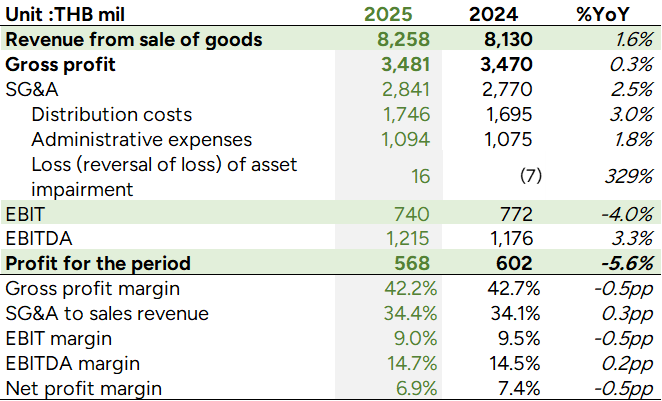
For year 2025, The Company reported sales revenue of 8,258.4 million baht, representing an increase of 1.6% YoY. Despite the slowdown in the beverage market, the company has effectively executed its marketing and market execution, enabling it to maintain market share and continuously strengthen its competitive position. Gross profit margin stood at 42.2%, a decrease of 0.5 percentage point YoY, reflecting the Company’s adjustment of its sales strategy in response to the softer market conditions as mentioned above.
Net profit for year 2025 was recorded at 568.3 million baht, representing a decrease of 5.6% YoY, due to provision of impairment costs of certain machinery and equipment, and higher selling expenses aimed at stimulating sales in a softening market. The Company recorded a net profit margin of 6.9 %, representing a decrease of 0.5 percentage point from the same period last year.
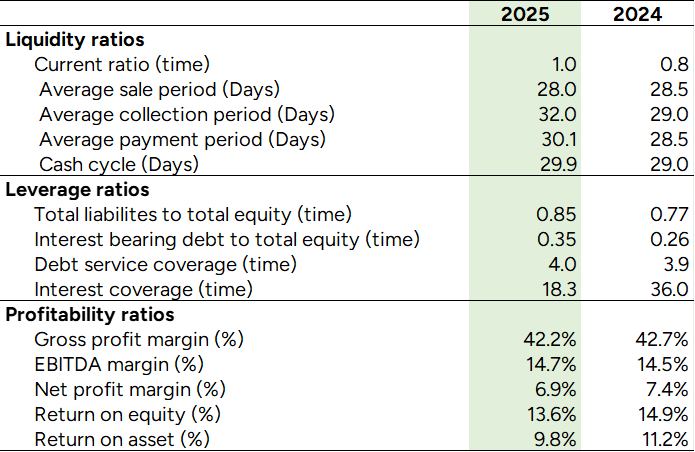
The Company's financial position continues to remain in a good position, with a debt-to-equity ratio of 0.8X and a favorable liquidity position as a cash cycle of 29.9 days.
Operating Results & Financial Condition
Other Analysis
| Title | Description | ||||||||||||
|---|---|---|---|---|---|---|---|---|---|---|---|---|---|
| 2. Performance Summary for year 2025 |
The Company reported sales revenue for year 2025 amounting to 8,258.4 million baht, an increase of 128.6 million Baht or 1.6% YoY, as a result of;
Gross profit margin for year 2025 was 42.2%, a decrease of 0.5 percentage points YoY. This was mainly due to a higher sales proportion of packaging sizes above 500 milliliters (pack mix), aiming to enhance value for consumers and sustain beverage sales amid softening market conditions. Other income amounted to 109.8 million baht, an increase of 50.6 million baht or 85.4 percent YoY, mainly driven by support received from The Coca-Cola Company to help stimulate sales amid the softening non-alcoholic beverage market. Selling and administrative expenses (SG&A) totaled 2,840.7 million baht, representing a 2.5% YoY increase, this was primarily driven by increased selling expenses aimed at stimulating sales in a softening market. Finance costs amounted to 40.5 million baht, an increase of 19.0 million baht or 88.7% YoY. This was attributable to long-term loans obtained to invest in machinery for the PET Line 3 production and the glass bottling line, as part of the Company’s long-term capacity expansion and operational efficiency strategy. Net profit, as reported in the consolidated financial statements, was 568.3 million baht, a decrease of 5.6% YoY, primarily due to provision of impairment costs of certain machinery and equipment, and higher selling expenses aimed at stimulating sales in a softening market. Net profit margin stood at 6.9%, reflecting a YoY decrease of 0.5 percentage points. | ||||||||||||
| 3. Financial Position Summary | 3.1 Statement of financial position summary
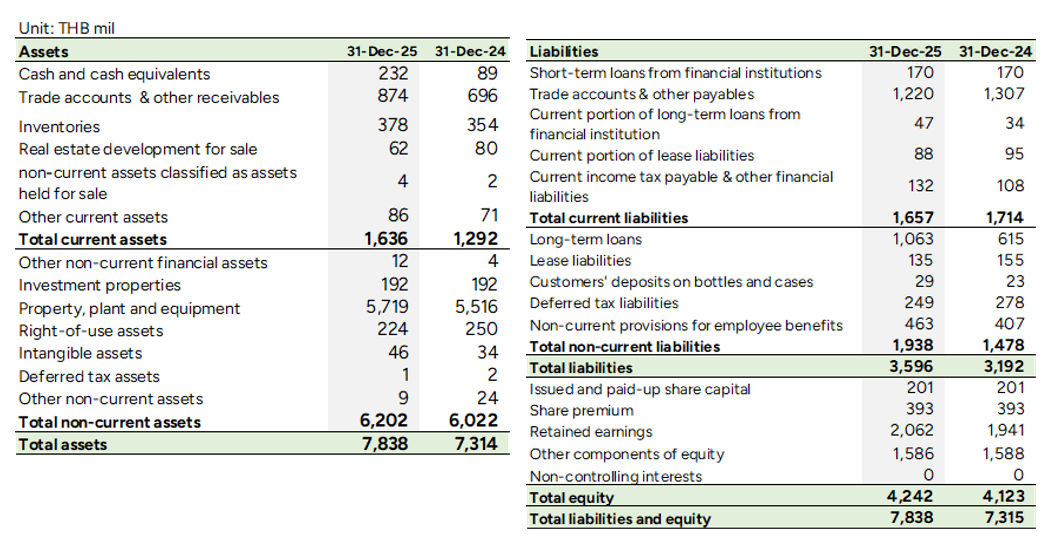
As of December 31, 2025, the Company had total assets amounting to 7,837.5 million baht, an increase of 552.9 million baht or 7.1% from December 31, 2024. The main reason for this increase was the rise in land, buildings, and equipment of 203.1 million baht, primarily due to 1) Investment in the glass bottle business, which includes the procurement of machinery to support the glass bottle packaging process and the construction of warehouse facilities for glass bottle storage; and 2) Renovation of branch office buildings and warehouse infrastructure to enhance operational efficiency and support future growth. As of December 31, 2025, the Company had total liabilities amounting to 3,595.6 million baht, an increase of 403.5 million baht or 12.6% from December 31, 2024. Primarily due to an increase in long-term borrowings amounting to 448.2 million baht. As of December 31, 2025, the Company had total shareholders' equity amounting to 4,241.9 million baht, an increase of 119.4 baht or 2.9% from December 31, 2024. The main reason for this increase was the rise in retained earnings. 3.2 Statement of cash flows summary Unit: Million Baht
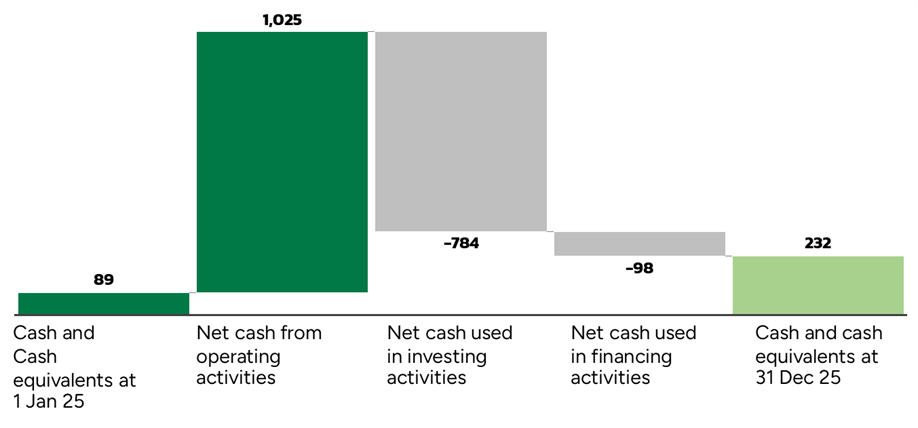
The Company had cash and cash equivalents amounting to 232.1 million baht as of December 31, 2025, an increase of 142.9 million baht from January 1, 2025. The Company had net cash flows from operating activities amounting to 1,024.6 million baht, net cash flows used in investing activities amounting to 784.2 million baht, primarily due to cash payments for land, buildings and equipment. Net cash flows used in financing activities amounting to 97.6 million baht, mainly from cash payments for the settlement of short-term borrowings from financial institutions and dividend payments were made in May and September 2025. 3.3 Financial ratios summary
In terms of operations for year 2025, the Company maintained a good cash cycle, with a duration of 29.9 days, which increased from 29.0 days in the same period last year due to an increase in collection day. The Company's debt repayment ability is at a good level with a debt-to-equity ratio of 0.8 times. The Company is able to cover its debt payment obligations by 4 times. The Company's gross profit margin for year 2025 was 42.2%, a decrease compared to 42.7% in the same period last year, The EBITDA margin was 14.7%, and the net profit margin was 6.9%. | ||||||||||||
| 4. Factors Influencing Future Operations or Growth | The Company anticipates that the Non-Alcoholic Ready-To-Drink (NARTD) market in Southern Thailand will experience modest growth in Q1’2026. The Company expects to continue benefiting from the onset of the tourism high season, which positively supports the tourism sector, along with government stimulus measures aimed at promoting domestic tourism and consumption. Nonetheless, there remain risks associated with geopolitical and global uncertainty. | ||||||||||||
| 5. Sustainability Performance Overview 2025 | In 2025, HaadThip Public Company Limited continued to operate under its ESG framework. The Company focused on balancing economic growth, environmental stewardship, and social development. These areas are key to maintaining competitiveness and delivering long-term value to shareholders. 5.1 Environmental
5.2 Community and Social
5.3 Corporate Governance HaadThip received top-level recognition for corporate governance and ESG performance from leading institutions, including:
|
Debt Securities with Financial Ratio Requirements
Debt Securities with Financial Ratio Requirements Issued?
No
Factors That May Affect Financial Condition
Factors or Incidents That May Materially Affect Financial Condition
Domestic sugar prices:
The Company prioritizes maintaining the unique taste standard that consumers trust, alongside efficient cost management in line with Office of the Cane and Sugar Board' sugar price adjustments to reflect domestic production costs. However, positive factors from declining global sugar prices due to increased production help alleviate raw material cost burdens and reduce pressure from the fourth phase of the sugar tax. Therefore, the Company focuses on continuously delivering original formula products of the same standard quality to consumers, while also promoting sugar-free product lines as a key initiative to respond to the health-conscious trend and consumer behavior shifting towards lower-sugar beverages. This approach of increasing healthy choices will help mitigate the impact of the tax structure and foster sustainable profit growth in the future.
Draft Act on the Control of Marketing of Food and Beverages Affecting Children's Health:
Currently, there is a push for a draft law to restrict marketing communications and promotions of high-sugar products to youths under 18 years old. This includes prohibiting advertising through all channels, banning price-value claims, and limiting sales and promotional activities in educational institutions and children's gathering areas. Although this draft law is still under consideration and not expected to be enforced in the near future, the Company has continuously monitored its progress and has consistently adhered to The Coca-Cola Company's Responsible Marketing Policy, an international standard that does not target marketing to children under 13 years old. Adhering to these strict internal standards not only aligns with the government's intentions but also helps the Company effectively manage regulatory risks.
Draft Sustainable Packaging Management Act:
The draft Sustainable Packaging Management Act is currently undergoing a public hearing process to establish mechanisms for packaging management based on the principle of Extended Producer Responsibility (EPR), which focuses on the systematic collection, aggregation, and reuse or recycling of packaging. This law is a subordinate legislation that still needs to go through several stages of consideration to reach concrete conclusions. Therefore, the Company has prepared a management plan and upgraded its operations to accommodate these changes, aiming to manage potential future cost risks and drive business in line with a sustainable circular economy.
Draft Climate Change Act and Draft Clean Air Act:
The process of considering the draft Climate Change Act focuses on systematically enhancing the country's greenhouse gas management and pollution control. Its key provisions include establishing criteria for reporting greenhouse gas emissions data, defining rights for waste gas discharge (Permit), and implementing carbon pricing mechanisms in the form of a Carbon Tax to incentivize industries to reduce pollution. Although these measures are still in the process of developing practical guidelines to align with international standards, the Company has proactively prepared by adopting a Carbon Accounting Platform to report performance across all three scopes (Scope 1-3). This supports Thailand's new Nationally Determined Contribution (NDC 3.0) target to reduce greenhouse gas emissions by 47% by 2035 and achieve Net Zero by 2050, which aligns with the ESG concept of sustainable environmental development.
As the Company has continuously implemented solar energy projects, including both rooftop solar panels (Solar Rooftop) and floating solar panels (Solar Floating), totaling over 9,000 panels, to serve as the primary renewable energy source in the production process, thereby reducing both greenhouse gas emissions and long-term energy costs. In the next phase, the Company will continue with its original plan to expand the installation of additional solar panels to replace fossil fuel energy, aiming to increase the proportion of solar energy use to 20% by 2027, demonstrating its commitment to adapting and responding concretely to climate change.
Risks from climate variability and water management:
Climate change conditions have led to more severe and unpredictable natural disaster phenomena, particularly floods in the southern region, which have affected transportation networks and distribution routes in some areas, such as the flood in Songkhla province that impacted sales channels and product transportation in some areas. The Company has closely monitored the situation and managed to adjust transportation routes as appropriate to ensure continuous product distribution.
Regarding the main production base in Surat Thani province, not physically affected. and the transportation of key raw materials into the production process due to such events. Furthermore, there is sufficient water resource readiness for production. consistently. In this regard, The Company has proactively prepared management and adaptation plans through area-specific risk analysis and the development of a Business Continuity Plan to reserve products and raw materials in secure strategic locations. This ensures that climate fluctuations will not significantly impact the Company's ability to deliver products and its financial standing.
Projects or R&D Affecting Future Results
Currently, the Company operates amidst the challenges of rapidly changing economic conditions and consumer behavior. Therefore, it continuously focuses on enhancing its competitive capabilities through investments in innovative operating systems and information technology infrastructure. Emphasis is placed on managing product pricing strategies appropriate for the purchasing power in each distribution channel, alongside research and development of new products (New Product Development), particularly in the functional drinks category, to meet lifestyle demands and expand the customer base to the younger generation. This will directly contribute to future revenue growth and market share.
To achieve maximum efficiency in reaching customers, the Company has expanded the use of digital systems to drive its distribution strategy. This involves implementing an e-B2B system to enhance the agility of distribution channels, allowing partners to order products at any time, reducing potential revenue loss due to out-of-stock situations at points of sale, and improving data collection efficiency for accurate analysis and operational plan adjustments. Furthermore, the Company applies Artificial Intelligence (AI) technology to support demand planning, supply chain management, and enhance efficiency in production and logistics processes, thereby reducing operational costs and maximizing partner satisfaction.
In addition to the aforementioned technology investments, the Company also prioritizes the development of information technology infrastructure and enhancing the digital expertise of its personnel. This is to support business expansion and effectively manage future risks. These initiatives are considered key mechanisms for strengthening business resilience and ensuring stable and sustainable financial growth.